Rescue of Nick Schuyler by the USCGC Tornado
Not Without HopeThe rescue of Nick Schuyler by the USCGC Tornado is the turning point of the 2009 Clearwater boating accident: after hours of uncertainty, a search across violent seas, and the deaths of Marquis Cooper, Corey Smith, and Will Bleakley, Nick’s survival becomes visible as a small orange signal against an immense and nearly featureless ocean. The operation does not erase the failures that preceded it, but it converts a missing-person case into a rescue when a lookout’s trained attention, Nick’s bright clothing, and a carefully executed water approach finally align.
Causes and Background
The emergency began with a chain of decisions surrounding Marquis Cooper’s fishing boat. Marquis had monitored a cold front and warned that the trip might be cut short if the water became rough, yet the four men continued toward their fishing site. When they prepared to return, the anchor would not come free. Marquis maneuvered the boat repeatedly while Will Bleakley and Corey Smith pulled from different directions, but the anchor remained fixed to the bottom. Frustration mattered because the group had experienced the same problem the previous week, when a friend had cut the anchor line and Marquis had paid two hundred dollars for a replacement anchor and rope.
The final attempt to free the anchor created the immediate mechanical cause of the disaster. The line was tied at the stern, Marquis tightened it, and he applied power. The anchor’s blades apparently dug in more deeply; the stern squatted, water poured aboard, the bow rose, and the boat listed to port. The men had no time to transmit a Mayday call. Nick Schuyler escaped into the water as the boat rolled, and the group’s first efforts to right it failed because the overturned hull offered no leverage while the submerged center console acted as a resistant rudder.
The Florida Fish and Wildlife Conservation Commission later identified three factors: the improper attachment of the anchor line to an eye bracket on the port side of the transom, the attempt to throttle forward against the anchor, and the failure to leave sufficient slack in the line. Nick’s retrospective account also identifies missing layers of preparation: the men should have been ready to send a distress signal, should have told others their exact destination, should have carried more flares and flashlights, and should have worn life jackets or known precisely where they were stored. The rescue therefore followed not a single isolated mistake but an accident chain in which weather, equipment, communication, and decisions compounded one another.
Search and Deployment
The Coast Guard station in St. Petersburg, Florida, received notice at 1:27 A.M. that a twenty-one-foot Everglades fishing boat was overdue after departing the Seminole Boat Ramp in Clearwater for a wreck roughly fifty nautical miles offshore. The initial report contained errors about the number and experience of the passengers, while the boat lay beyond the effective range of the Coast Guard’s communications towers. A handheld GPS eventually supplied coordinates, but the position was about ten miles south of the supposed wreck site, enlarging the search area rather than resolving it.
The delay had immediate survival implications. Coast Guard Captain Timothy Close noted that if the men had been reported promptly after capsizing, rescuers would still have had daylight and could have reached them sooner. The overturned boat was especially difficult to detect: instead of presenting a large upright profile, it might show only a small portion of white hull among hundreds of thousands of whitecaps. Cloud cover from the cold front, limited moonlight, rough water, and the absence of an emergency position-indicating radio beacon further reduced the search’s precision. An EPIRB could have transmitted the boat’s location and identification automatically or manually; without one, the operation depended on incomplete reports, drifting estimates, and visual detection.
The search intensified after sunrise. A Jayhawk helicopter launched at 7:09 A.M. and reached the area at 7:45, while a forty-seven-foot motor lifeboat arrived at the supplied GPS coordinates at 7:10. The seas were running eight to ten feet, with some waves reaching twelve feet; wind approached thirty miles per hour, and visibility was only half a mile. The conditions were so violent that Close compared the lifeboat’s passage to an extreme amusement-park ride. These conditions shaped the rescue before the rescuers ever reached Nick: every sighting could vanish behind a crest, and every approach risked becoming another maritime emergency.
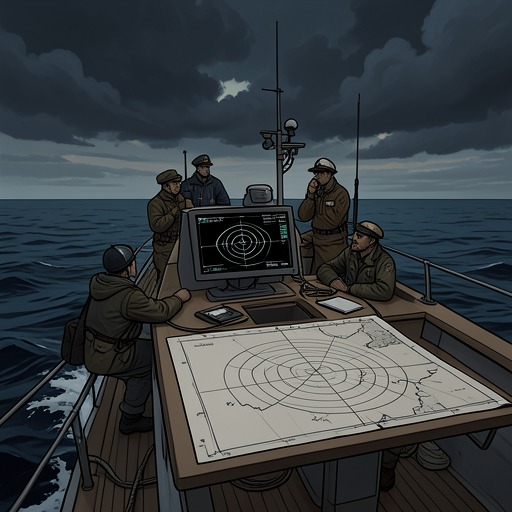
The USCGC Tornado entered the operation after receiving changed orders at 2:40 P.M. on March 1. It had been on routine patrol in the Florida Straits, off Cuba, operating on one engine in quiet seas, with ordinary duties involving law enforcement, illegal fishing, and vessel-safety compliance. Lieutenant Commander Patrick Peschka diverted the cutter 230 miles north toward the search area off Tampa–St. Petersburg. Many crew members learned the reason for the diversion through the Internet and understood that they were headed toward the search for four missing football players.
The Sighting
On Monday morning, after standing watch from midnight to four and returning to the bridge at about 9:30, Coast Guardsman Michael Briner joined three lookouts scanning the daylight water. His training emphasized peripheral vision: objects could be found more quickly by noticing what did not belong in the wider field of view than by staring directly at the sea. At 11:43 A.M., about thirty-eight miles west of Tampa, he saw a speck of orange beside a white wave. The wave kept returning instead of breaking and disappearing. At first it seemed an odd place for a buoy, but there were no buoys in that part of the Gulf of Mexico.
Briner called the bridge’s attention to the object. At roughly five hundred yards off the starboard side, he held his gaze on what appeared to be no more than a basketball in the water. Then the shape resolved into a person. The bridge confirmed that someone was alive, and the atmosphere aboard the Tornado changed immediately from methodical searching to urgent action. Peschka later credited Nick’s bright colors and his position on the back of the overturned boat with helping make the sighting possible, while Briner recognized that a different wave crest might have hidden him from the cutter entirely.
The rescue depended on visibility that was both fragile and specific. Nick wore an orange life jacket and an orange winter jacket over a sweatshirt, with gloves and the hood pulled over his head. Against whitecapped water, the orange clothing supplied the contrast that the overturned boat itself lacked. Yet the sighting was not treated as a conclusion. The man repeatedly disappeared behind waves, forcing the rescue boat’s coxswain, crew members, and swimmer to stand as tall as possible to keep him in view while they approached.
Water Rescue
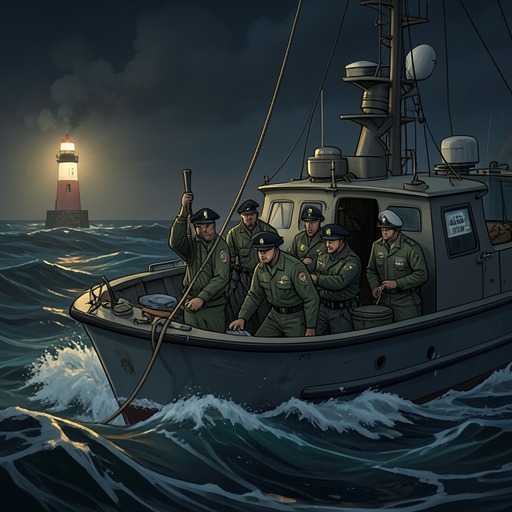
A general alarm sounded aboard the Tornado, and the crew prepared its twenty-three-foot rescue boat, a hybrid craft with a rigid fiberglass hull and an inflatable collar. David Earles, the cutter’s rescue swimmer, had just finished lunch in the mess hall when he learned that a person had been found. He hurried aft, put on a short-sleeved wetsuit and a harness attached to a rope, and joined the launch. Earles was twenty-five, had served in the Coast Guard for less than two years, and had never before been called upon to conduct a water rescue; he had expected the missing boaters to be located and lifted from the sea by helicopter.
The rescue boat could not simply pull alongside and lift Nick from the overturned hull. The seas were six feet, whitecapped, and rough, so the rescuers backed away after an initial approach. Nick was sitting with his head lowered and his shoulders slumped, holding on to the motor. Earles asked whether he was all right, and Nick answered that he was. The exchange established that Nick remained conscious, but his position on the hull and his prolonged exposure showed how narrow the margin had become.
Earles then entered the water rather than waiting for a safer side-on extraction. He reached Nick, handed him a flotation device, and instructed him to float on his back while a crew member reeled them in with the rope attached to Earles’s harness. The directness of the procedure mattered: the swimmer became the link between the rescue boat and the exhausted survivor, while the tether controlled the distance in the unstable sea. Earles reassured Nick with the exact words, “Relax,” and “I’ve got you.”
Only twelve minutes passed between Briner’s sighting and Nick’s arrival aboard the rescue boat. Nick was barely able to keep his eyes open, yet the approach itself brought sensation back into his body. He repeatedly thanked the rescuer and was given a red flotation device. His response was not passive relief alone: when told to stay where he was while the rescue craft came to him, he was already preparing to enter the water because he had been sitting on the boat for so long and was determined to reach the larger vessel. The rescue thus required both Earles’s intervention and Nick’s final exertion in a state of extreme weakness.
Consequences and Significance
The Tornado rescue restored a living person to the search-and-rescue system, but it also confirmed the scale of the preceding disaster. Nick was the sole survivor among the four men who had left Clearwater. The discovery did not produce a simple triumph, because Marquis Cooper, Corey Smith, and Will Bleakley were dead, and Nick’s survival was inseparable from the question of why the others had not been found in time. The rescue marked a value reversal from apparent disappearance and probable death to life, but it left grief and responsibility in its wake.
The operation also demonstrates how recovery barriers can succeed after earlier safety barriers fail. Weather monitoring did not prevent the trip from continuing; the return decision led to an anchor-line crisis; life jackets, distress equipment, and precise location information were inadequate; and the overturned boat was hard to see. Yet a handheld GPS narrowed the search enough to direct resources, the Tornado’s diverted crew maintained a visual lookout, Briner recognized an anomalous orange speck, Nick’s clothing increased his visibility, and Earles completed the final physical link. Survival emerged from the alignment of human vigilance, equipment, procedure, and chance rather than from personal strength alone.
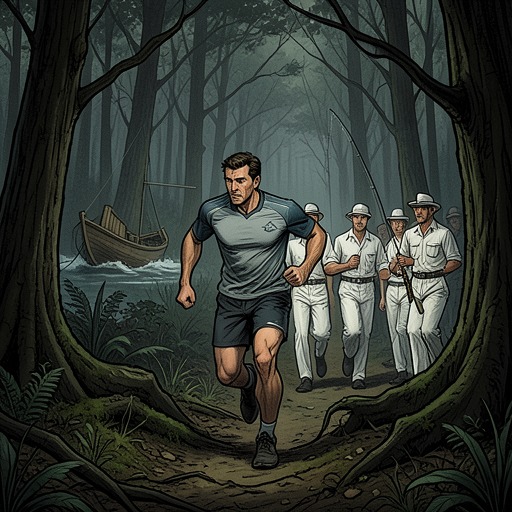
For Nick, rescue did not end the event’s consequences. He later returned to training and used demanding workouts to direct stress and anger into physical effort, but he said the intensity he had shared with Marquis and Corey never fully returned. He also continued to revisit the accident through counterfactual questions about the anchor, the life jackets, and whether lending Will his winter jacket might have changed the outcome. The cutter’s brief twelve-minute intervention therefore stands at the center of a much longer aftermath: it saved Nick’s life while binding that life to memory, survivor’s guilt, and the permanent knowledge that a barely visible person in a violent sea can represent the difference between a search and a rescue.